Home › Services
Drain field repair in Knoxville, from soggy spots in the yard to a full rebuild
The tank gets most of the attention, but the drain field does most of the work. It is the stretch of yard where liquid leaving the tank soaks into soil and gets cleaned before it reaches groundwater. When that soil stops accepting effluent, you see it: a squishy patch that never dries, grass greener than the rest of the lawn, a smell on warm evenings, drains that slow after every storm. This page explains how a field treats wastewater, why fields on East Tennessee clay and rock run into trouble, which fixes have a real track record and which are oversold, and what a rebuild or expansion involves.
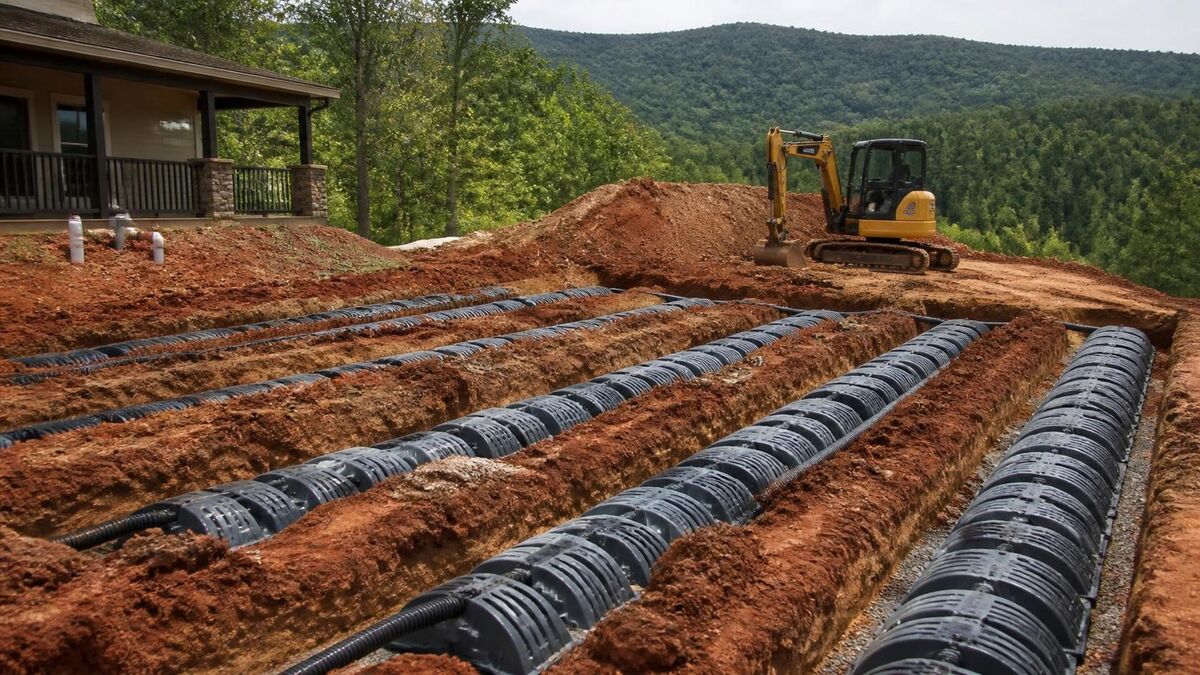
How a drain field cleans wastewater once it leaves the tank
The liquid flowing out of a septic tank is not clean. It still carries dissolved organic matter, nutrients and bacteria. The field, also called an absorption or leach field, spreads that liquid through perforated pipe or plastic chambers set in shallow trenches. From there it seeps down through unsaturated soil, where air in the pore spaces lets aerobic microbes break down what remains and the soil itself filters out pathogens.
The key word is unsaturated. Treatment depends on a zone of soil above the seasonal water table and above rock where water moves slowly enough to be worked on but fast enough not to pond. If effluent hits saturated ground or fractured rock too quickly, it travels without being treated. That is why soil depth and drainage drive how a field is designed in the first place.
The biomat: the living layer that controls how fast a field drains
Within months of a field going into service, a dark, slimy layer forms where effluent meets the soil along the trench bottom and sidewalls. This biomat is made of bacteria, the gummy substances they produce and fine particles they trap. A healthy biomat is normal and even useful, because it slows effluent down and evens out how it spreads, which improves treatment.
Trouble starts when the biomat thickens faster than soil microbes can consume it. That happens when the field is loaded with more water than it was sized for, when solids or grease escape the tank, or when the soil below stays waterlogged so the air-loving microbes that eat the mat cannot survive. A thick, sealed biomat lets effluent pond in the trench, rise toward the surface and back up into the tank.
Signs a drain field is struggling
Fields rarely fail overnight. The early clues are easy to dismiss as a wet spring or a slow drain, so it pays to know what to watch for across the seasons.
- Spongy or wet ground over the trenches during dry weather, or puddles that smell faintly of sewage.
- Stripes or patches of grass that are noticeably greener and faster-growing over the lines.
- Drains that slow down or gurgle after heavy rain and then recover a few days later.
- A tank liquid level that sits above the outlet pipe when the lid is opened.
- Sewage odor drifting across the yard, especially in the evening or after laundry day.
- Effluent seeping out of a slope below the field, often showing as a dark wet stain or algae.
Why fields fail on East Tennessee clay, rock and slopes
Some causes are common everywhere, and some are tied to the ground around Knoxville. Much of the region sits on ridge-and-valley terrain with clay soils over limestone and shale, shallow rock in places, and rain that arrives through every month of the year. Each of those affects how much effluent a trench can take.
- Hydraulic overload: more people, a new bathroom, a leaking toilet or a water softener discharging into the system can push more water than the field was built to absorb.
- Solids carryover: a tank pumped too rarely, or one with a missing outlet baffle, sends sludge and grease into the trenches where they clog the soil.
- Compaction: driving, parking or running heavy equipment over the field squeezes air out of clay and can crush pipe.
- Roots: trees and thirsty shrubs planted near the lines send roots into perforations and trench gravel.
- High water: a seasonal water table, a spring line on a hillside or roof and driveway runoff directed over the field keeps the soil saturated.
- Shallow rock or karst: trenches cut close to bedrock, or above fractured limestone, have little treatment depth to work with.
Diagnosing the field before deciding on a fix
A field that looks wet might be failing, or it might be getting flooded by something fixable upstream. A careful contractor starts by ruling out the easy causes. That usually means pumping and examining the tank, checking the outlet baffle and filter, looking for running fixtures inside the house, and confirming that gutters, sump pumps and surface drainage are not dumping water onto the trenches.
From there, the field itself gets probed or opened at inspection ports to see how deep effluent is standing in the trenches. Uneven ponding can point to a tilted distribution box rather than a worn-out field, and component problems like that are covered on the septic repair page. For a home sale or a full condition report, a formal septic inspection documents the findings.
Resting a field and switching between alternating fields
A biomat that has thickened because of overloading can sometimes recover if the soil gets a break. When effluent stops arriving, the trenches drain, air works back into the soil, and microbes start consuming the mat. Resting usually takes months rather than days, and it only works if there is somewhere else for wastewater to go in the meantime.
Some properties already have that option built in: two fields with a diversion valve that sends flow to one while the other rests. If yours has one, switching on a regular schedule spreads the workload and extends the life of both. Where only one field exists, resting may mean adding a second field or extending the existing one, which needs design approval from the permitting authority.
Jetting, aeration and other rejuvenation methods, and where they fall short
Several treatments are marketed as ways to bring a failing field back without digging. Some have a place; none are cure-alls, and a reputable contractor will tell you plainly when the soil is beyond help.
- Line jetting: high-pressure water scours solids and slime out of perforated pipe. It helps when the pipe is clogged, but it does nothing for soil that has sealed beneath the trench.
- Soil fracturing or air injection: forcing air into the soil around the trenches can open pathways for a while. Results vary with soil type, and tight clay tends to close back up.
- Aerobic retrofits: adding an aerator to the tank lowers the strength of effluent so the biomat thins. It can extend the life of a marginal field but adds equipment, power use and service needs.
- Additives and enzymes: the evidence that poured-in products restore a field is weak, and none of them replace pumping or fix overloading.
- Chemical treatments: some products can harm soil structure or groundwater and may be restricted by the authority for your address.
When a field needs to be replaced or expanded
If the soil under the trenches has sealed, the pipe has collapsed, or the field was undersized from the start, the answer is new absorption area. Sometimes the contractor can build fresh trenches beside the old ones in undisturbed soil. Sometimes the original area is abandoned and a new field goes elsewhere on the lot. On tight sites, poor soil or shallow rock may push the design toward a pump-fed or alternative layout.
In Tennessee, field replacement is not a dig-and-go job. It generally starts with a soil evaluation and a repair permit through TDEC Division of Water Resources or the county program serving the property, followed by an inspection before the trenches are covered. The authority decides what layout fits the site. When the tank and field both need replacing, the work becomes a full system project, and the new septic systems page explains that path.
What a drain field rebuild usually involves, step by step
Every site is different, but a typical replacement on a residential lot follows a familiar order once the decision is made.
- Locate the existing tank, lines and field, and call 811 so buried utilities are marked before anyone digs.
- Have the soil evaluated in the proposed area so the permitting authority can review what the ground will support.
- Obtain the repair permit and the approved layout, including trench locations and the type of distribution.
- Pump the tank and correct any upstream defects, such as a missing baffle or a cracked outlet line.
- Excavate the new trenches, set the pipe or chambers to the approved grade, and connect the distribution.
- Call for the required inspection while everything is still open, then backfill and grade the surface.
- Seed or mulch the disturbed area so grass can root and protect the field from erosion.
Cost drivers and what a field proposal should include
Drain field work is priced after a site visit, because the variables are large. The contractor will look at how much new trench the design calls for, the type of media used, whether the field needs a pump or pressure distribution, how far the equipment has to travel across the yard, slope and rock conditions, permit and soil evaluation requirements, and how much restoration the lawn will need.
A complete proposal names the cause of failure as the contractor sees it, the approved layout, the materials, who handles permits and inspections, what upstream fixes are included, and how the disturbed ground will be finished. It should also state whether workmanship coverage applies and what it covers.
Protecting a drain field so the repair lasts
A new or recovered field will fail again if the conditions that killed the first one remain. Most protection is simple habit.
- Keep vehicles, trailers, livestock and heavy equipment off the field at all times.
- Plant only grass over the trenches, and keep trees and large shrubs well away from the lines.
- Steer gutter downspouts, sump discharge and driveway runoff away from the field.
- Fix running toilets and dripping fixtures promptly, and spread laundry across the week.
- Keep the tank on a pumping schedule matched to your household, with an effluent filter cleaned at each visit.
- Do not build patios, sheds or play sets over the field or the area reserved for a future one.
Getting a soggy yard or slow drains looked at near Knoxville
Field trouble shows up across the region, from hillside lots in Halls Crossroads and Corryton to clay ground around Clinton and fast-growing subdivisions in Sevier County. Communities the site covers are listed on the service areas page. If you are seeing wet spots or slow drains, send the address and what you are noticing, and someone who handles field work in the region will be in touch about a visit.
Drain Field Repair: questions people ask
How long does a drain field last?
There is no fixed lifespan. A field on deep, well-drained soil serving a household that conserves water and pumps the tank on schedule can last for decades. One on tight clay, sized for a smaller family, or fed solids from a neglected tank may struggle much sooner. The things that shorten field life are mostly controllable: overloading, solids carryover, compaction and roots. A contractor looking at your site can give a far better read than any general number.
Can a failing drain field fix itself?
Sometimes, partially. If the problem is a biomat thickened by a period of heavy use, cutting the water load sharply or resting the field can let soil microbes thin it out over time. That recovery is slow and is most practical on properties with a second field to switch to. A field with crushed pipe, roots throughout, or soil that sits saturated most of the year will not heal on its own and needs repair or replacement.
Why is the grass greener over my septic lines?
Effluent carries water and nutrients, and grass over the trenches picks up some of both. Faint green stripes during a dry summer can be normal on a working field. The concern is grass that is dramatically lusher, growing in a spreading patch rather than lines, or sitting on ground that feels soft and wet. That pattern suggests effluent is rising too close to the surface and the field should be checked.
Does rain make a septic drain field back up?
It can. Heavy or prolonged rain raises soil moisture and the water table, leaving less room for effluent to soak in. A healthy field usually handles it with little notice, but a marginal one may slow down, gurgle or back up until the ground dries. Roof and driveway water routed across the field makes this worse. If backups track closely with storms, the field is likely near its limit, and redirecting surface water is often the first step.
Is drain field jetting worth it?
Jetting is worth it when the problem is inside the pipe: solids, grease or slime clogging the perforations so effluent cannot reach the trench. It is not worth much when the soil under the trench has sealed, because blasting the pipe clean does not reopen clay. A contractor should be able to show you, through inspection ports or a camera, which situation you have before recommending it. Treat a promise that jetting alone will save any field with caution.
Can I put a patio or shed over my drain field?
It is a bad idea. Soil over a field needs air exchange and evaporation to do its job, and hard surfaces or structures cut both off. The weight can compact soil and crush pipe, and anything built there blocks access when the field needs work. Many properties also have an area set aside for a future replacement field, which should stay open too. Check with the authority for your address before building anywhere near the system.
Talk through your site
Start with the address, what you want done, and a few photographs of the area, including anywhere water sits after a heavy rain.
Related work
Septic Tank Pumping
Pumping on a sensible schedule, what the crew should check while the lid is open, and how often is too often.
Septic Inspections
Inspections for home sales, refinances and routine checkups: what a real inspection looks at and what it cannot see.
Septic Repair
Baffles, lids, risers, pipes, pumps and alarms: the failures that can be fixed without replacing the system.
New Septic Systems
New and replacement systems: soil evaluation, permits, conventional and alternative designs on East Tennessee ground.
Across the metro
Powell
North Knox County homes on hilly lots, older systems and a mix of sewer and septic streets.
Halls
Halls Crossroads ridges and hollows, rocky soil, and systems tucked into sloped back yards.
Seymour
Fast-growing ground between Knoxville and the Smokies, much of it on septic, much of it new.
Clinton
Anderson County homes on clay and limestone, lake-area lots and older rural systems.