Home › Services
Septic inspections around Knoxville that tell you what the system is really doing
A septic inspection is the closest thing a homeowner or buyer gets to an X-ray of a system buried in East Tennessee clay. Around Knoxville, a large share of homes outside the sewer lines sit on tanks and fields that nobody has looked at in years, and a sale is often the first time anyone asks hard questions. A good inspection opens the tank, checks the parts that wear out, walks and probes the field, and writes down what was seen and what could not be seen. This page explains the difference between a quick look and a full evaluation, what happens during a real-estate inspection, how to read the report, and when buyers and sellers should schedule one.
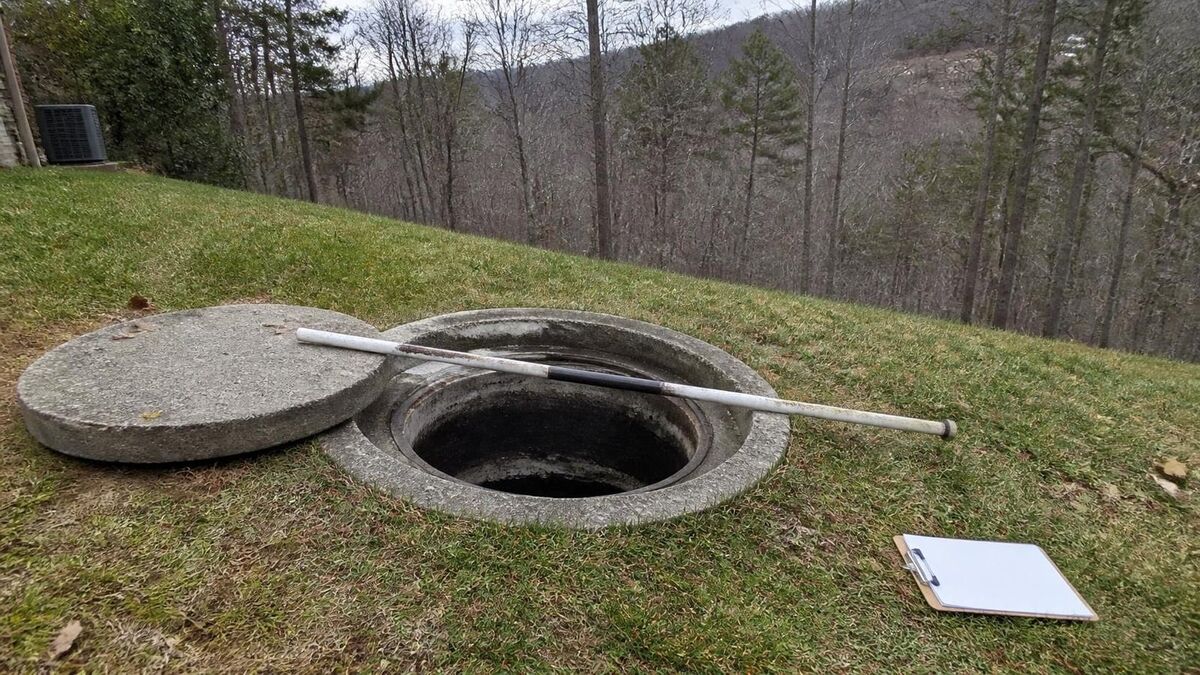
Visual checks versus a full septic inspection
The word inspection gets stretched over two very different jobs. A visual check usually means someone asks about the home's water use, runs a few fixtures, looks at the yard over the tank and field for wet spots or odor, and perhaps flushes a dye tablet to see whether color shows up on the surface. It tells you only whether the system is failing loudly that afternoon.
A full inspection goes underground. The tank lids are exposed, the liquid level is checked, the tank is usually pumped so its walls and fittings can be seen, the baffles and any filter are examined, and the drain field is located and probed. Pumps, floats and alarms are tested on systems that have them. The result is a written description of each component and its condition. If someone offers you an inspection, ask plainly which of these two you are getting, because a passing visual check and a passing full inspection mean very different things.
What a real-estate septic inspection should cover
Buyers in Knox, Anderson, Sevier and Union County are increasingly asking for a septic evaluation before closing, and some lenders or loan programs call for one. Whatever the reason, a thorough sale inspection normally includes the items below. If the scope you are quoted leaves several of them out, ask why.
- A records search for any permit, system drawing or past pumping receipts on file for the address.
- Locating the tank, distribution box and drain field, with rough measurements back to the house.
- Opening every tank compartment and noting the liquid level before anything is disturbed.
- Measuring sludge and scum, then pumping so the tank interior can be seen.
- Checking inlet and outlet baffles, the effluent filter if one exists, and the tank walls and lid for cracks or root entry.
- Probing the field to judge soil saturation and look for ponding in the trenches.
- Testing any effluent pump, float switches and high-water alarm.
- A written report with photos, a description of every component and a clear note of anything that could not be accessed.
Why pumping is usually part of the inspection
An inspector looking into a full tank sees mostly the top of the scum mat. The inlet baffle may be hidden, the outlet tee may be half buried, and cracks in the walls are under several feet of liquid. Pumping during the inspection lets the inspector see the whole interior, and it also reveals something you cannot learn any other way: whether liquid flows back into the tank from the field side once the level drops. Backflow is one of the clearer signs that the soil downstream is not taking water.
Pumping right before an inspection, without the inspector present, works against the buyer. An empty tank cannot show its normal operating level, and a tank emptied the week before a sale hides any sign that it was sitting high. If you are buying, ask whether the tank was serviced recently and by whom. If you are selling, let the pump-out happen during the inspection rather than ahead of it. Routine service intervals and what goes into a pump-out are covered on the septic tank pumping page.
Baffles and filters: small parts that decide how long a field lasts
Baffles are simple, and that is why inspectors give them so much attention. The inlet baffle sends incoming waste downward so it does not churn the scum layer. The outlet baffle, or a sanitary tee, draws liquid from the middle of the tank so floating solids stay behind. In older East Tennessee tanks those fittings were often concrete, and gases inside the tank slowly eat them down to a stub.
An effluent filter, where one has been installed, sits at the outlet and catches fine particles before they leave. During an inspection the filter should be pulled and its condition described. A filter caked solid is not a failure in itself, but it is evidence that solids are reaching the outlet, and it means the household should be cleaning it more often. A missing outlet baffle with no filter is one of the more important findings in any report, because it means solids have likely been reaching the field for some time. Fixing those parts belongs to septic repair.
Probing the drain field and reading the soil
The field is where most of the cost lives if something is wrong, and it is also the hardest part to see. Inspectors locate the trenches, often by following the line from the tank or distribution box, and then push a probe into the ground along and beside them. What the probe brings up, and how wet and how dark it is at trench depth, says a lot about whether effluent is soaking away or standing in the gravel.
In the ridge-and-valley clay around Knoxville, a field can look perfect from the surface while the trenches below are saturated. The reverse also happens: a soggy patch in a low corner of the yard may be runoff from the slope above, not effluent. A good inspector separates those cases rather than guessing, and notes the weather in the days before the visit, since a week of heavy rain changes what the soil reads like.
Hydraulic load tests and why inspectors disagree about them
A hydraulic load test runs a large, measured volume of water into the system, often over an hour or more, and watches whether the tank level rises, whether water surfaces over the field, or whether it backs into the house. The idea is to simulate heavy use and see whether the field keeps up.
The test is debated for good reasons. A field that has been sitting unused in a vacant house may pass because the soil has dried out, then struggle a month after a family moves in. A field on the edge of failing can be pushed over that edge by the test itself, leaving the seller with a problem that the test created. Some inspectors use a load test only when other evidence is unclear, some use a gentler version, and some avoid it entirely. If one is proposed, ask how much water will be used and what the inspector will consider a pass.
Camera inspection of the lines between house and field
A sewer camera on a flexible push rod can travel from a cleanout through the building sewer into the tank, and sometimes from the tank or distribution box out into the field lines. It shows root intrusion at joints, sagging sections that hold water, crushed or separated pipe, and whether the distribution box is sending flow evenly to each trench.
Camera work is not part of every inspection. It earns its cost when there is a backup history, when the house sits a long way from the tank, when large trees grow near the line, or when an older home has clay or cast iron pipe leaving the foundation. On a sale, a short video can settle whether a slow drain is a plumbing problem or a septic one.
What no septic inspection can prove
An inspection describes conditions on the day of the visit. It cannot promise how long a field will last, how the system will handle a larger family, or what a wetter year will do to soil that is already marginal. Inspectors cannot see every inch of a trench, and many older East Tennessee systems were installed before anyone kept careful drawings, so parts of a field may simply not be found.
Read the limits section of any report as carefully as the findings. Phrases like not accessible, not located or not tested are not filler; they mark the parts of the system you are still taking on faith. If an important component falls into that category, you can ask for further work before closing, such as exposing a distribution box or running a camera through a line.
How to read a septic inspection report
Reports vary in format, but the useful ones answer the same questions. Work through it in this order.
- Check what type of inspection was done and which components were actually opened, pumped or tested.
- Look at the tank section: liquid level before pumping, sludge and scum depth, baffle and filter condition, any cracks, roots or leaks, and whether backflow was seen.
- Read the field section for probe results, surface signs and where they sit relative to the trenches.
- Find any pump, float and alarm results if the system uses an effluent pump.
- Read every limitation and note what could not be inspected.
- Separate maintenance items, like cleaning a filter or adding risers, from repairs and from signs of field failure, because each carries a very different cost.
- Look at the photos. A described crack is easier to judge when you can see it.
Timing an inspection for buyers and for sellers
Buyers should build the septic inspection into the contract's inspection period with enough days to get results back and, if needed, a contractor's opinion on repairs. If the report turns up a field problem, the buyer needs time to get a scope of work before deciding whether to renegotiate.
Sellers have a different choice. Inspecting before listing costs the same as inspecting later, and it turns surprises into known items you can fix, price into the listing, or disclose on your own terms. For homes where failure is already obvious, the drain field repair page explains the options downstream of the tank.
What changes the cost of a septic inspection
The contractor sets the price after learning about the property. The main drivers are the type of inspection, whether pumping is included and how large the tank is, how deep the lids sit and whether risers exist, how hard the field is to find on an older lot, whether a pump, alarm or second tank is involved, and whether camera work or a load test is added. Steep lots and long hose runs add time.
If you have a closing date coming up, send the address, the timeline and anything you know about the system so a septic contractor working the region can tell you what the inspection will involve. Communities served are listed on the service areas page.
Septic Inspections: questions people ask
How long does a septic inspection take?
A visual check can be done in well under an hour. A full inspection with pumping, field probing and component checks usually takes a few hours, and more when the lids are deep, the field is hard to find, or a camera or load test is added. Records searches happen beforehand and the written report follows afterward, so allow several days from scheduling to having the finished document in hand.
Does a septic inspection fail or pass a house?
Many reports avoid a simple pass or fail and instead describe each part as functioning, functioning with maintenance needed, or showing signs of failure. That is more useful, because a cracked lid and a saturated field are very different problems. If a report does use pass and fail language, read the details behind the verdict. A buyer and lender usually care about the specific findings and the cost to address them, not the label at the top.
Who pays for a septic inspection when buying a house?
That is negotiated in the purchase contract, and practice varies. Buyers often pay because the inspection protects their decision, but some sellers order one in advance to speed the sale, and some contracts split the cost or make the seller responsible for any pumping. Talk it over with your agent before signing, and make sure the contract gives the buyer enough time to act on the results.
Can a septic inspection be done in winter or after heavy rain?
Yes, but conditions change how the field reads. After days of rain, East Tennessee clay can be saturated even over a healthy field, and a probe may suggest trouble that is really weather. Frozen ground is less common here but can make digging and probing slower. A good inspector notes recent rainfall in the report, and if results look borderline in very wet weather, a recheck in drier conditions can be worth asking about.
What is the dye test for a septic system, and is it enough?
A dye test involves flushing colored tablets or liquid down the toilet, running water, and watching the yard for color breaking the surface. If dye appears, the field is clearly failing. If it does not, that proves very little, because effluent can be backing up underground, the field may have been rested in a vacant house, or the dye may simply take longer than the visit. Treat a clean dye test as one small data point, never as a full inspection.
Should I get a septic inspection if I am not selling?
It is worth doing if you bought the house without one, if you have no idea when the tank was last serviced, or if you are planning an addition, a new bathroom or more people in the home. A baseline report with lid locations and component condition makes every later service call faster. It also catches small fixes, like a failing baffle, before they become field damage.
Talk through your site
Start with the address, what you want done, and a few photographs of the area, including anywhere water sits after a heavy rain.
Related work
Septic Tank Pumping
Pumping on a sensible schedule, what the crew should check while the lid is open, and how often is too often.
Septic Repair
Baffles, lids, risers, pipes, pumps and alarms: the failures that can be fixed without replacing the system.
Drain Field Repair
Wet spots, slow drains and odors from a failing field, and the options from rest to rebuild.
New Septic Systems
New and replacement systems: soil evaluation, permits, conventional and alternative designs on East Tennessee ground.
Across the metro
Powell
North Knox County homes on hilly lots, older systems and a mix of sewer and septic streets.
Halls
Halls Crossroads ridges and hollows, rocky soil, and systems tucked into sloped back yards.
Seymour
Fast-growing ground between Knoxville and the Smokies, much of it on septic, much of it new.
Clinton
Anderson County homes on clay and limestone, lake-area lots and older rural systems.